
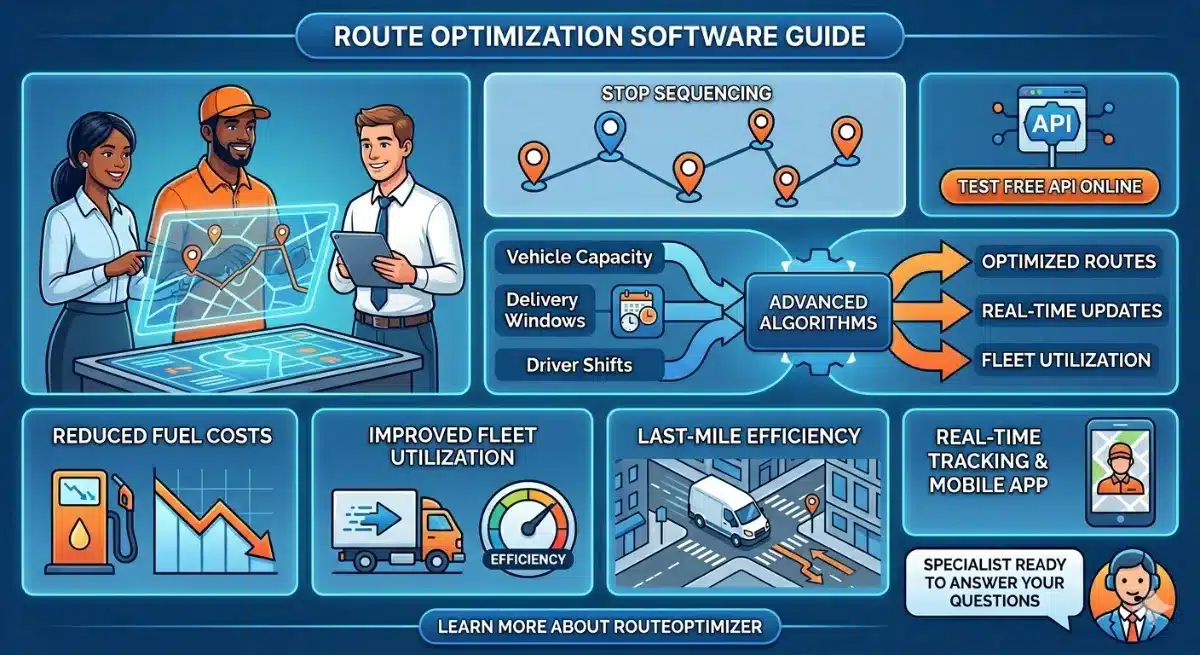
In the modern logistics landscape, simply getting from point A to point B isn’t enough. To stay competitive, businesses must transition from basic planning to advanced route optimization software.
This technology does more than suggest directions – it serves as a powerful decision-support system that automates order assignment and stop sequencing to minimize costs.
Why Traditional Route Planning Falls Short
While many use the terms interchangeably, there is a significant difference between route planning vs. route optimization. Traditional planning often relies on manual spreadsheets that can’t account for the “Vehicle Routing Problem” (VRP). Without an automated system, operations frequently suffer from:
- Underutilized vehicles and rising fuel consumption.
- Missed delivery time windows, leading to poor customer satisfaction.
- Inaccurate ETA calculations due to real-time traffic variability.
- Long idle time in case of early arrival to stop
How Modern Optimization Works
Advanced platforms, such as City & Carrier, utilize optimization algorithms to evaluate millions of potential route combinations in seconds. The software processes critical data points to ensure every plan is realistic and executable:
- Operational Constraints: It factors in vehicle capacity, driver shifts, specific service requirements and road closures.
- Real-Time Data: By integrating with telematics and ERP systems, the software adapts to live traffic and unexpected road changes.
- Dynamic Adjustments: Drivers stay connected via a mobile driver app, allowing for instant updates and digital proof of delivery.
Key Business Benefits
Implementing a dedicated solution for last-mile delivery or long-haul distribution typically yields measurable results:
- 15–25% reduction in transport costs through optimized fuel usage and mileage.
- 5–10% improvement in fleet utilization, allowing you to do more with fewer assets.
- Increased on-time delivery rates by precisely modeling arrival times and service durations.
What makes last-mile delivery hard to plan?
- Volume swings. Seasonal peaks and events change how many vehicles and drivers you need from week to week.
- Customer expectations. Same-day options, live tracking and a reliable arrival time are now the norm, not a bonus.
- Failed deliveries. Wrong addresses, recipients who are not at home and remote, low-density areas lead to repeat attempts, extra cost and extra emissions.
- Cost versus speed. Customers want fast delivery but often choose the cheapest option, so every route has to be both quick and efficient.
Route optimization software answers these with daily re-planning, accurate arrival times and status updates for recipients. In City & Carrier, tracking and notifications are part of smartDelivery.
Choosing the Right Solution for Your Operation
When evaluating route optimization tools, look for features that bridge the gap between planning and execution.
A “best-in-class” platform should offer scenario simulation to prepare for seasonal demand, multi-trip routing capabilities, and a user-friendly interface for both dispatchers and drivers.
By leveraging route optimization, your business can transform complex logistics into a streamlined, data-driven operation that reduces emissions and boosts the bottom line.
Optimize your fleet today. Explore our routeOptimizer solution and test the API for free in the Route Optimizer API documentation.
Have questions? Our specialists are always available to provide expert support. Contact Us


