
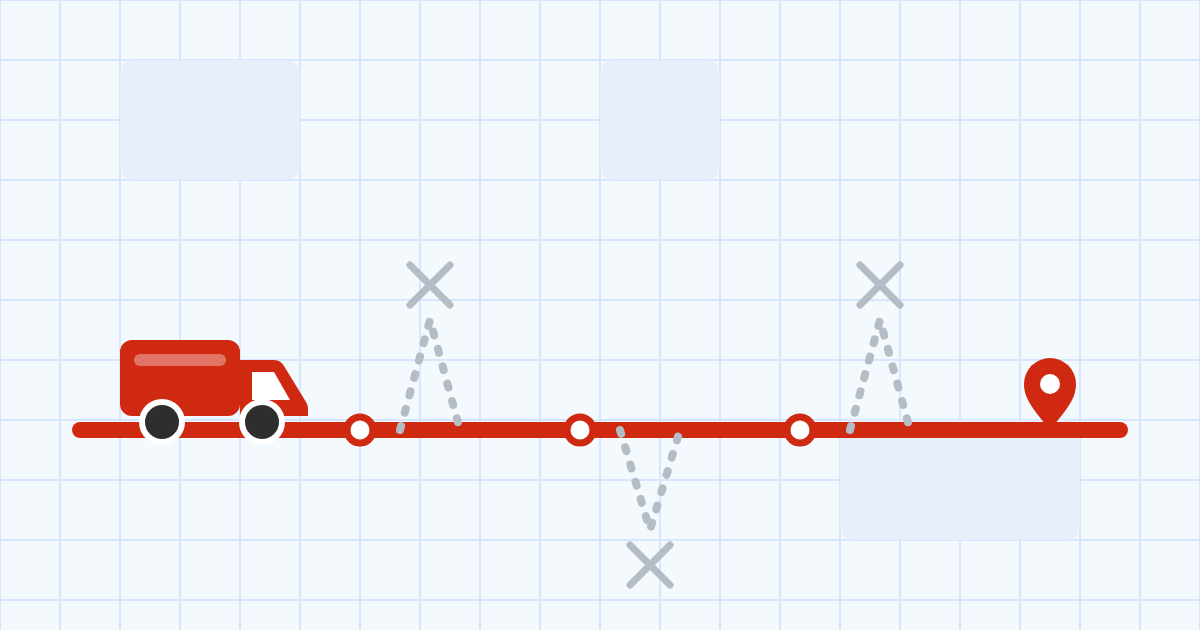
You cut empty kilometres on an InPost or DPD round by fixing the stop order before you leave the depot, grouping locker and door stops together, and re-planning the moment the day changes. Most wasted driving isn’t traffic. It’s doubling back: crossing the same estate twice, returning to a Paczkomat you passed an hour ago, or driving out to one far stop and back.
Those kilometres come out of your own pocket. Most couriers delivering for InPost run their own sole-trader business rather than being employees, so fuel and van costs are theirs (Super Biznes). Below is a routine you can run in a few minutes every morning.
Where empty kilometres come from
On a typical parcel round, empty kilometres pile up in four places.
- Loading order instead of route order. The van is loaded as parcels come off the sort, and the day follows the load.
- Nearest-next by instinct. Heading for whichever stop looks closest feels efficient, but it leaves stragglers that pull you back across town at the end.
- Lockers and doors in separate passes. A Paczkomat or DPD Pickup point handled on its own trip, then a door delivery 300 metres away an hour later.
- Failed deliveries. Incomplete addresses, missing intercoms and unanswered phones are everyday problems for Polish couriers (Forbes.pl). Each one can mean a second visit.
The distances involved are big. An InPost courier delivers about 70 parcels a day on average and drives 100 to 300 km, depending on the region (swyft.pl). At busy times, routes of around 200 parcels are described as normal (Forbes.pl). On that mileage, a little doubling back adds up fast.
How much does stop order matter? In a City & Carrier study of 60 simulated delivery routes in Warsaw, Kraków and Wrocław, an optimised order of 40 stops was a median 13% shorter than going nearest-next. The routes were simulated, not driven, so treat that as a sense of scale rather than a promise for your round.
Before you leave the depot: a five-minute routine
- Get every address into one list. Don’t plan from the parcels in your hands. Put the whole day’s stops into a route planner first, so you can see them on one map.
- Check the awkward addresses. Villages, new estates and addresses with no flat number cause the most trouble. Couriers in Poland regularly complain that apps can’t find local addresses; one App Store review says an exact address was placed "490km away" (App Store PL review). Zoom out once: any pin outside your area is a typo.
- Optimise the full list, then look at the shape. A good route is roughly one loop. Spikes out and back, or lines that cross each other, usually mean wasted kilometres.
- Fix the order before customers are told it. DPD tells recipients by email or SMS when the courier will arrive and shows the courier on a map on delivery day (DPD Polska). Settle your order early, then stick to it rather than improvising.
- End the loop near the depot. Late returns cost money: couriers report that InPost can charge PLN 100 for arriving late to the morning pickup or the evening return (Super Biznes). Plan the last stops on the side of town closest to it.
- Load the van in route order. First stops by the door, last stops at the back. Five minutes of loading saves digging at every stop.
On the road: keep the plan working
- Treat each locker as one stop. A Paczkomat or Pickup point with ten parcels is still one stop. Do the doors around it in the same pass, from the same parking spot where you can.
- Know where you’ll park before you arrive. Since September 2026, couriers delivering for InPost can be fined up to PLN 5,000 for documented illegal parking while servicing a Paczkomat, such as on a pavement or a lawn (Super Biznes, dlahandlu.pl). InPost says it has only tightened enforcement of existing contract terms. Couriers say some lockers stand next to no-stopping signs. For lockers you visit every day, note the nearest legal spot and walk the extra metres. A route planner won’t solve parking, but planning the stop around it will.
- Phone only when it saves a trip. "Jak mam 220 paczek i każda minuta się liczy, to nie jestem w stanie dzwonić" ("With 220 parcels and every minute counting, I can’t make calls"), one courier told Forbes.pl. Save calls for far-off stops where a failed attempt would mean driving back.
- Re-optimise when the day changes. A cancelled stop, an extra pickup or a road closure? Re-run the order for the stops you have left instead of squeezing the change in where it looks close.
- Don’t chase a missed stop straight away. If nobody answers, move on and pick it up when the route passes nearby again, not by turning round.
- Keep a list of problem addresses. Gate codes, hidden entrances, the right side of a block. Ten seconds of notes today saves a lap of the estate next week.
At the end of the day: a two-minute check
Compare the kilometres on your odometer with the planned route. A gap of more than a few kilometres tells you where the plan broke: a wrong pin, a missed stop, a detour you didn’t need.
Then add any new problem addresses to your list. Tomorrow’s route starts better if today’s surprises are already written down.
Related reading: the definitive guide to route optimization and the free route planner for up to 50 stops. All our guides and research in one place: route optimization guides and research.
Plan tomorrow’s round with Delivery Planner
Delivery Planner is a free route planner for couriers on iOS and Android. Add up to 50 stops for free, with no limit on the number of routes (fair use). Type an address, say it out loud or take a photo of the label, then optimise the whole order in one tap.
Get Delivery Planner free and run tomorrow’s five-minute routine with it.
Sources
- Super Biznes, 28 Sept 2026: InPost fines for couriers
- dlahandlu.pl, 29 Sept 2026: PLN 5,000 fines at Paczkomaty
- Forbes.pl, 28 Sept 2026: couriers under pressure
- swyft.pl: how many parcels an InPost courier delivers a day
- DPD Polska: receive your parcel
- App Store PL: route planner listing and reviews
- City & Carrier: route optimisation on 60 simulated Polish routes


